A Narrow Gap? Measure These 4 Things Before Buying a Storage Cart
A cart can look narrow enough in a photograph and still be awkward to use. The available space may change near the floor, a handle may project beyond the shelf, or there may be nowhere to pull the cart out. Use these four checks to decide whether a movable cart, a fixed shelf or no additional unit makes sense for your space.
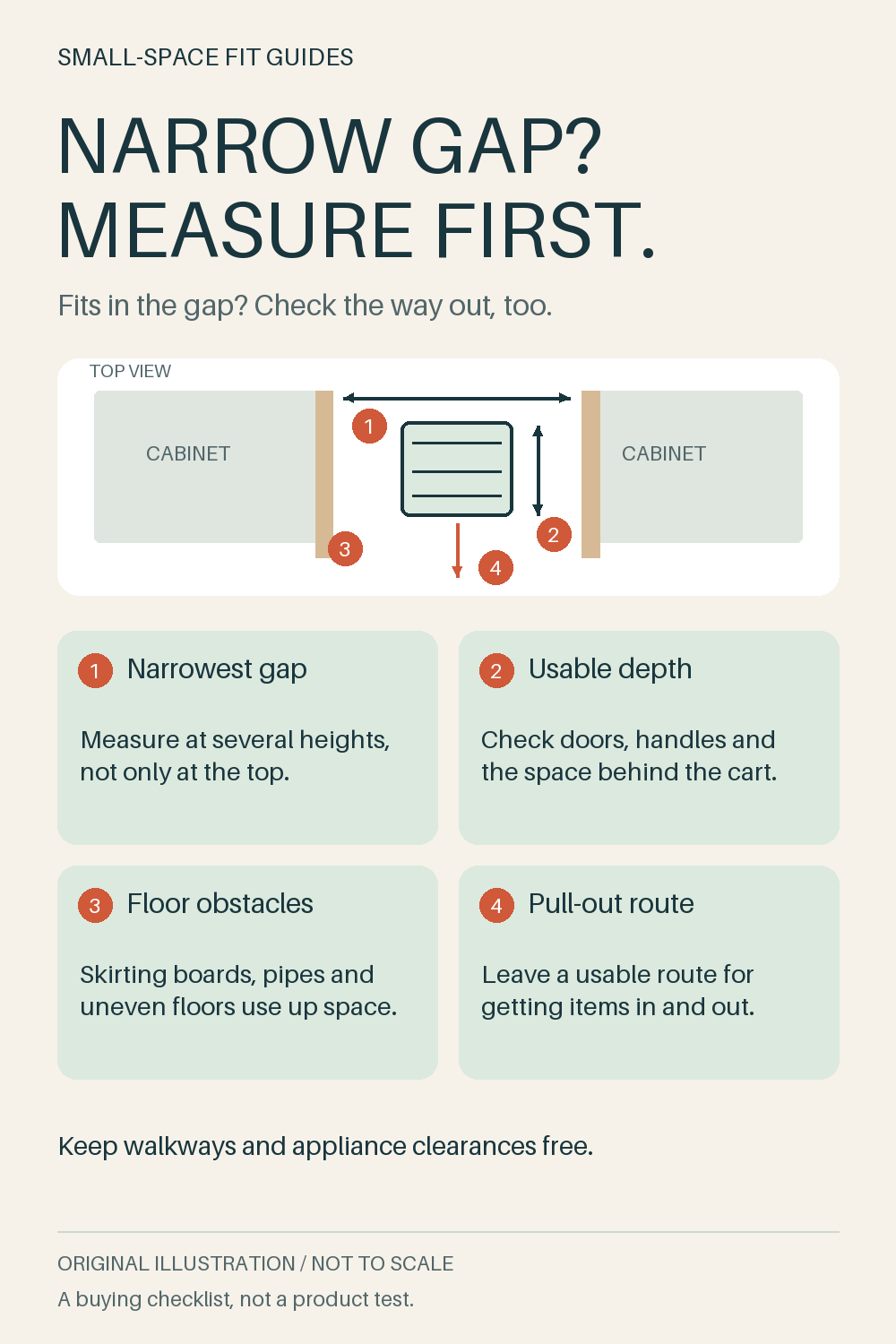
Download the original checklist image
1. Narrowest gap
Check the opening at the top, middle and near the floor. Walls and cabinets are not always parallel. Compare the smallest usable opening with the cart's maximum outside dimensions, including handles, wheels and projecting fixings. A nominal shelf dimension may not describe the widest part of the unit.
2. Usable depth
Measure how far the cart can go without obstructing a door, pipe, socket or other item that needs access. Check which dimension the retailer calls width and which it calls depth; rotating the cart may change how it can be used. Storage must not occupy ventilation or service clearances required by nearby appliances.
3. Floor obstacles
Look below shelf level for skirting boards, baseboards, pipework, raised thresholds and flooring changes. These can reduce the opening or affect how the wheels move. Do not assume that a cart will behave on your floor as it does in a studio photograph. Follow assembly and stability guidance instead of removing parts to force a fit.
4. Pull-out route
Plan where the cart will move when you need something from the back. Check the wheel direction, turning room and access with nearby doors open. Some narrow carts do not swivel like larger trolleys. Keep walkways and required access clear. If there is no useful movement route, compare an open bin or a different storage location instead.
Before you order
Use one unit system throughout your comparison, either centimetres or inches, and confirm the retailer's stated dimensions and load limits. Consider the weight and shape of what you will store, assembly requirements and return terms. A cart is only a useful space-saving purchase if you can safely reach and move its contents.
Your fit worksheet
Use centimetres or inches consistently. These cells are intentionally unfilled: we have not measured your space or approved a product for it.
| Check | Your space or equipment | Product requirement | Status |
|---|---|---|---|
| Narrowest gap | Record your measurement or observation | Confirm with the maker | Not checked |
| Usable depth | Record your measurement or observation | Confirm with the maker | Not checked |
| Floor obstacles | Record your measurement or observation | Confirm with the maker | Not checked |
| Pull-out route | Record your measurement or observation | Confirm with the maker | Not checked |
Reference and evidence limits
Retailer example: IKEA VESKEN cart, US listing.
The linked retailer page and its public customer feedback supplied research leads, not independent performance evidence. Comments can reflect individual experiences. We have not independently reproduced them or verified compatibility, stock, price, load limits or current numerical specifications. Check the product page and instructions for your market before buying. Source reviewed on 2026-09-21.